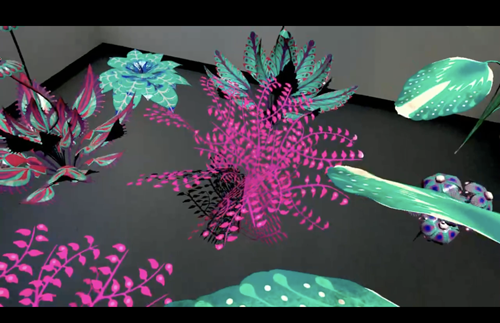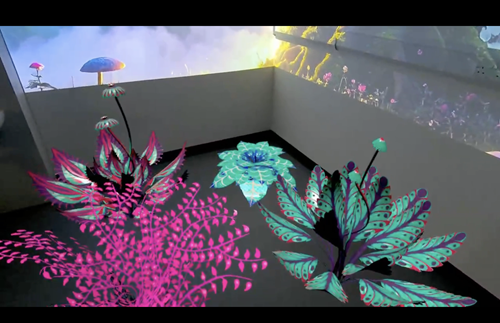

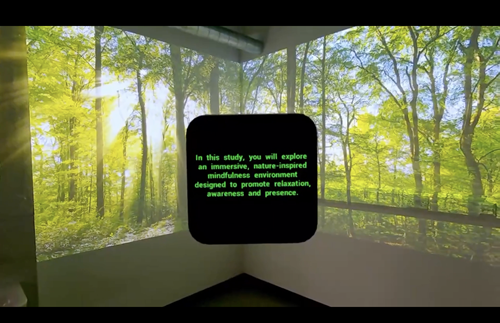
The Mindfulness Room is a dedicated research and wellbeing space designed to support the development, testing, and evaluation of digital mental health interventions. The facility provides a controlled environment where participants can engage with mindfulness-based activities, immersive technologies, and therapeutic digital content. The room is equipped to facilitate research involving mindfulness practice, relaxation techniques, augmented reality (AR), and nature-based therapeutic experiences, while also serving as a comfortable space for participant engagement and data collection.
Purpose of the Lab
The primary purpose of the Mindfulness Room is to support research exploring innovative approaches to mental health and wellbeing. The facility enables research that investigates the effectiveness, usability, and user experience of digital interventions, including mindfulness applications, augmented reality environments, and nature-based therapeutic technologies. The room supports participant recruitment, intervention delivery, qualitative and quantitative data collection, and the development of evidence-based approaches to improving psychological well-being.
Funding
Supported through funding from the UK Research and Innovation (UKRI).
Participate
Evaluating the Impact of an Immersive Room or an AR Headset Incorporating Mindfulness Techniques and Nature on Mood, Burnout, and Anxiety.
Do you ever feel overwhelmed, burnt out, or anxious?
We’re exploring how immersive environments and augmented reality (AR) tools
Using mindfulness techniques might help support you.
Who can participate:
- Adults (18+) with varied experiences in mental health help-seeking, mindfulness, and AR, including both users and non-users of digital mental health tools, with normal to corrected vision and hearing.
- Willing to participate in a mindfulness immersive experience in either a mindfulness room or in an AR headset over 8 weeks.
Exclusion Criteria:
- Current or past psychosis, Severe PTSD, where mindfulness may trigger flashbacks or re-traumatisation. Acute or severe mental health episodes (e.g., significant distress, severe anxiety or depression), as mindfulness may intensify symptoms.
- Augmented Reality headsets create immersive visual experiences, including flashing lights, rapid image changes, or intense visual patterns. Therefore, not suitable for individuals with photosensitive epilepsy.
This study has received ethics approval from the Heriot-Watt School of Business, Design & Social Sciences (BDSS) Ethics Committee. Any questions, please contact me, Angela Sener at as494@hw.ac.uk or Dr Mel McKendrick at m.mckendrick@hw.ac.uk
Strep credits will be awarded to Heriot-Watt Psychology students who participate.